
Raptors
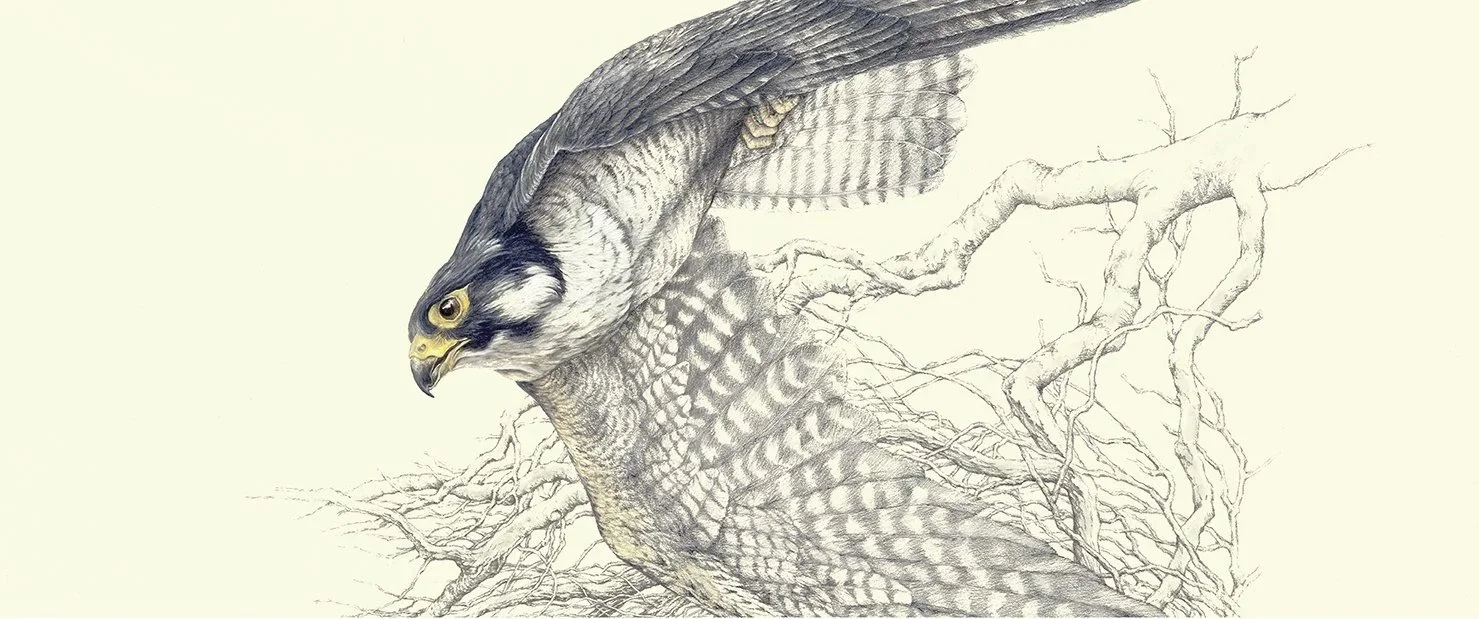
“Forming a Flight Plan”
Peregrine Falcon
This beautiful falcon is the fastest creature on earth. In a dive he’s been clocked at 240 mph and he inhabits every continent except Antarctica. Once endangered in North America, conservation efforts have given the peregrine population a good recovery. They prefer open country, coastlines and mountains but have adapted to cities and now nest on skyscrapers. I live in the woods but had one at the small pond in my backyard. He stayed on a tree branch for quite a while….maybe drawn by the bird feeders and looking for an easy meal. I was able to get my binoculars and I’m sure it was a peregrine! A very rare treat!
Archival giclee signed and numbered limited edition (500) from a gouache and pencil original

“Winter Sycamore”
American Kestrel
This is a small and very beautiful falcon! Such wonderful color and markings. They feast on insects, small rodents, reptiles and even birds - and they hunt by hovering in midair like a drone before dive bombing their meal! You’ve probably seen them hovering over grassy areas alongside the road. That’s the kestrel! They want wide open spaces with great views and they are everywhere in North America. Look for the black markings on their faces for a quick identification.
The large branches in the background are from a photo I took along the Buffalo River in Arkansas. It’s a sycamore and I think the twists and turns of its growth are very striking. The branch work behind the sycamore depicts the gray blur of thick winter woods. That took some time but, again, I love doing tangles!
Archival giclee signed and numbered limited edition (500) from a gouache and pencil original
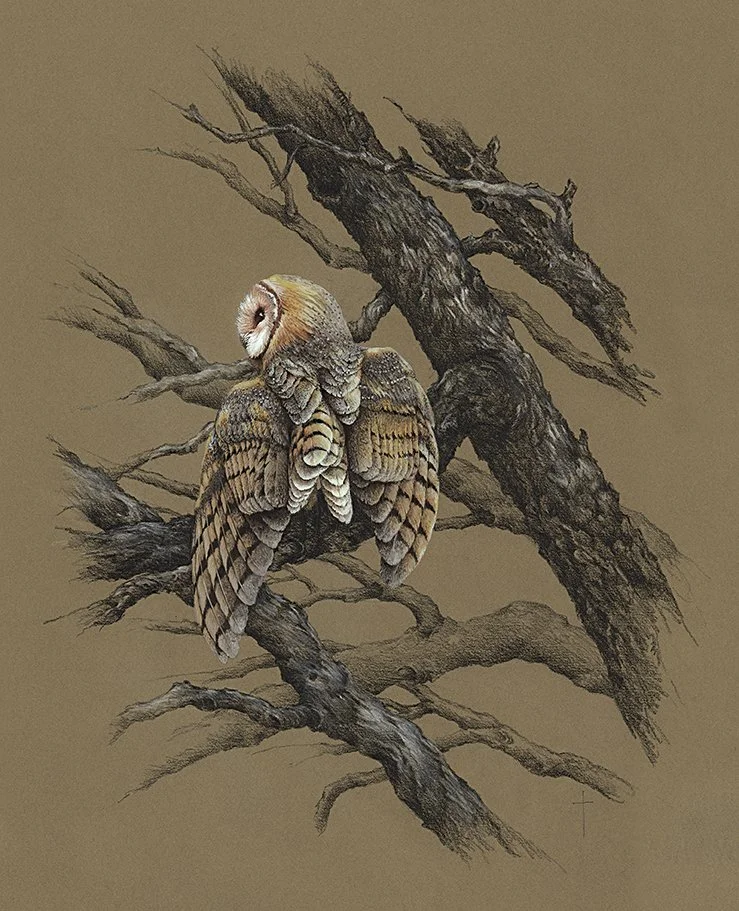
“Night Ghost”
Barn Owl
The reference for this painting came from a photo I took at a raptor rehab center just west of St Louis. I think they specialize in wolfs now. I was really intrigued by the way the feathers layer along the wings and down the owl’s back. Beautiful soft feathers but each very distinct. An owl’s feathers don’t have hard edges. The edges are fringed and that difference gives them a silent flight. The barn owl has a heart shaped white disk for a face and that shape traps and funnels sound. Their hearing is exceptional! They can hear a mouse’s heartbeat in a thirty square foot room. They are found in deserts, grasslands, forests, fields and even urban areas and nest in barns, tree hollows and nest boxes. A beautiful owl.
Archival giclee signed and numbered limited edition (500) from a gouache and pencil original

“Just Before Dawn”
Great Horned Owl
This intense fella was a resident at a raptor rehab center west of St Louis. I took the photo and thirty years went by before I got to his portrait. He has a really serious look and seems not happy about our presence. He has been disturbed and is now fluffed out and alert. The great horned owl is North America’s most common owl and they have amazing night vision. This owl is a visual hunter. The “horns” aren’t horns at all but tufts of feathers and they have nothing to do with the owl’s ears but the tufts are a good indicator of the owls mood. Like dogs, the owl can flatten them if he feels threatened. Happy and those tuft stand up and become the horns he’s named for. So, I guess this fella is just shaking loose his magnificent feathers and not aggravated after all!
Archival giclee signed and numbered limited edition (500)
from a gouache, pencil and pastel original

“Nocturnal Sentinel”
Great Horned Owl
This is a big and powerful owl that preys on mammals as big as skunks and on other birds as big as ducks. With extremely good hearing and night vision he watches, swooping down from a high perch to snag a meal with those big talons. When clenched, the talons require a force of 28 pounds to open…this is a strong predator! They don’t work on a nest very much - just use the old nest of another large bird like a hawk, eagle or heron and add a few feathers. The female incubates the eggs but they both feed the owlets. Populating a big range they are found through out the U.S., most of Canada, all of Central America and parts of South America. Individuals may wander but there is no real migration
Archival giclee signed and numbered limited edition (500)
from a gouache and pencil original

“The Eyes Have It”
Great Horned Owl
What wonderful big eyes! They are nocturnal hunters with pupils that expand widely and retinas packed with rods. In dim light they can see 100 times better than humans. Their eyes are not a sphere but are shaped like cylinders and that helps them see in the dark. But, the tube like shape of their eyes prevents them from rotating in the sockets. Instead, their necks have an extra vertebrae that enables them to turn their heads up to 270 degrees around. This big owl is the one who inhabits our storybooks and legends. He is so impressive and those golden eyes are mesmerizing!
Archival giclee signed and numbered limited edition (500)
from a gouache and pencil original

“Soaring Free”
Red-tailed Hawk
One of the most common hawks in North America, the red-tailed hawk is at home in deserts, grasslands, coniferous and deciduous forests, agricultural fields and urban areas. When soaring they travel at about 40 mph and in a dive they can reach 120 mph. This big hawk is can weigh as much as 3.5 lbs with a wingspan of 57 inches. They mate for life taking a new mate only if the original mate dies. They are easily trained hunters and often used for falconry. They are also long-lived and disease resistant so a falconer can have a trained bird for many years. The hawk won’t bring the prey back to the falconer though. The falconer has to find the hawk and trade a bit of meat for the prey. A fun fact, red-tailed hawks have a two or three second, hoarse, rasping scream similar to a steam whistle. Hollywood frequently substitutes a red-tail’s call for an eagle because the eagle’s call isn’t nearly as impressive.
Archival giclee signed and numbered limited edition (500)
from a gouache, pastel and pencil original

“On A Wing & A Prayer”
Bald Eagle
The fierce drama of a bald eagle emerging from a calm blue background. Powerful raptors with a wingspan of up to eight feet they primarily hunt fish but also eat small mammals, birds and carrion. They build largest nests in the world, often mate for life, and with their remarkable eyesight can spot prey a mile away.
Archival giclee signed and numbered limited edition (500)
from a gouache and pencil original

“Home Sweet Home”
Barred Owl
This youngster is ready to leave home but hesitant. It’s a big world out there and home has been safe and easy. He is a woods owl and likes water nearby. In fact, this fella is a bit of a fisherman. He will wade into shallow water to catch fish, crayfish and frogs. His call is a “Who cooks for you? Who cooks for you-all?”. They do not migrate and many spend their entire lives in just a small radius. We hear barred owls in our woods all year long. My husband is good at calling them closer but so are our neighbors so we really don’t know if it’s an owl or the folks up the road!
Archival giclee signed and numbered limited edition (500)
from a gouache and pencil original

“Early Spring”
American Kestrel
This is a small and very beautiful falcon! Such wonderful color and markings. They feast on insects, small rodents, reptiles and even birds - and they hunt by hovering in midair like a drone before dive bombing their meal! You’ve probably seen them hovering over grassy areas alongside the road. That’s the kestrel! They want wide open spaces with great views and they are everywhere in North America. Look for the black markings on their faces for a quick identification.
These branches have leaf buds that are swelling up. Spring is not quite here but the buds say it’s coming!
Archival giclee signed and numbered limited edition (500)
from a gouache and pencil original

“At Home in the Woods”
Barred Owl
Barred owls are sometimes out in the daylight. This one is traveling through the woods bathed in the green light filtering through tree leaves. He will be gone before you can blink but, for this split second, he’s a feathered blessing in shades of green.
Archival giclee signed and numbered limited edition (500)
from a gouache, pastel and pencil original
The raptors seldom frequent my backyard but its always a special thrill to have such a visitor! We have big windows in our living room with recliners right there! Perfect seating for all the woods activity every morning and evening.
Barred owls live in our woods. We hear them often and see them occasionally. A biologist friend of mine has seen them fish but the closest I’ve come to that is seeing a barred owl pluck an unlucky frog off the edge of our pond. He watched the pond from a dogwood and made several tries before he scored his breakfast. Another time, I watched a barred owl bathing in the shallow end of that same pond. He performed the act just like any songbird bobbing and spreading his wings and then drying off in the dogwood above. These moments make my day!
Both the barred owls and broad-winged hawks occasionally monitor my feeders. My usual customers vanish or gang up to drive the intruder off. Everybody can take part in this mobbing but the crows and bluejays are most effective! We live just within the woods so the peregrine that landed in the dogwood was a little out of his usual habitat. He spent a long time just hang’n out near the bird feeder before moving on. I had time to get binoculars and counted myself very lucky to see him!
The raptors are not as accessible as songbirds or even many waterbirds but they are very visible in the air above us and definitely make an impression. They are less approachable than the songbirds and so seem to be of some more primal and mysterious world.
All of the prints are archival giclees produced by us and in our studio. The term "giclee" refers to the printing process. This process provides wonderful color accuracy and detail without the dot pattern of an offset lithograph. David scans the original and uses photoshop to correct colors. Color correcting is a skill and can go quickly or take days of trying. We have a large format Epson printer and use Epson's archival inks on acid-free Somerset Velvet paper. The inks are light-fast and under normal household conditions will not fade for 100 years.