
Woodpeckers
Pileated woodpeckers share my woods with red-bellied, downy, hairy, and an occasional red-headed woodpecker. I’ve often watched the pileated at work on deadwood near the house, where chunks fly as it chisels relentlessly, first at one angle, then another. One spring, a courting pair performed just outside the kitchen windows. They clung to opposite sides of a trunk, spiraling up and down for nearly half an hour, pausing now and then to peek around and be sure they still held the other’s attention. Eventually, they disappeared together to somewhere more private—a brief spring flirtation.
Woodpeckers are the carpenters of the bird world. Their ability to excavate nest cavities makes them valuable neighbors, as many other birds later move into the homes they leave behind. Their skull, bill, and muscle structure are uniquely adapted to absorb tremendous impact, protecting them from injury as they hammer for insects or hollow out nests. A woodpecker’s bill can strike a tree at speeds of 20 to 23 feet per second, with forces reaching 600 to 1500 Gs—far beyond what most car crashes produce. Truly remarkable birds.

“The Girl Next Door”
Pileated Woodpecker
The female here is busy after an insect hiding in the decaying tree and her hammering has caught a male’s attention. She is the lovely girl next door and he will remember her when spring arrives. There’s a white-tailed buck wandering through, unconcerned about the noise . These are large, crow-sized birds and they don’t migrate. They are common in our Ozark woods but we hear them more than we see them.
Archival giclee signed and numbered limited edition (500) from a gouache and pencil original

“Spring Flirtation”
pileated woodpecker
We watched this scene unfold just outside our kitchen windows! The birds spiraled up and down the tree trunk staying on opposite sides. Now and then they would stop and in a moment one would peek around to see if the other was still there. I was spring and we think this was courtship. The performance lasted a good half hour before they flew off for privacy. It was wonderful!
Signed and numbered limited edition giclee (500) from a gouache & pencil original
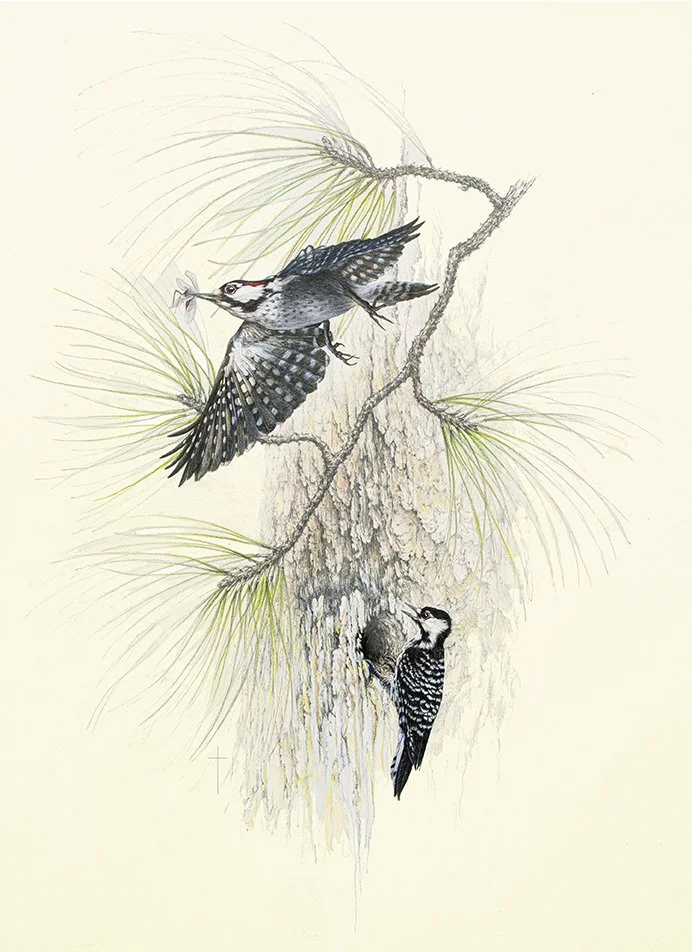
“Family Planning”
Red-Cockaded Woodpeckers
This is an endangered woodpecker and naturalists are working hard to increase its range and population. It was once common in the southern forests but depends on mature long-leafed pines for nesting. Those forests were harvested affecting the woodpecker’s population. The long-leafed pine is susceptible to red heart fungus giving the tree a soft center inside a hard outer shell. Perfect for excavating a nest cavity. The bird also has a unique way of protecting its nest. It’s the only woodpecker that carves its nest from a live pine and it drills holes around the opening. Resin seeps from those holes creating a sticky barrier that repels climbing predators. Clever!
Archival giclee signed and numbered limited edition (500) from a gouache and pencil original.

““The Ivory-billed Woodpecker - The Ghost Bird”
The ivory-billed woodpecker was once the largest woodpecker in North America, an imposing and magnificent bird of the deep southern forests. With its striking black-and-white plumage and distinctive ivory-colored bill, it earned the nickname “The Lord God Bird,” a name whispered in awe by those fortunate enough to glimpse it.
Historically, it inhabited the vast bottomland swamps and old-growth hardwood forests of the southeastern United States, where towering cypress and ancient trees provided both food and nesting sites. As logging reshaped those wild landscapes in the late 19th and early 20th centuries, the bird’s habitat disappeared, and so did confirmed sightings.
Today, the ivory-billed woodpecker exists in a space between memory and mystery. Reports and fleeting encounters continue to surface, yet none have been supported by clear, indisputable photographic evidence. Whether it survives in some remote stretch of southern swamp or has quietly slipped into extinction remains one of the greatest and most poignant questions in the bird world — a symbol of both hope and loss in America’s natural history. You can google it for more information. The search for a surviving population continues and a “maybe sighting” was in Arkansas not ago.
Signed and numbered limited edition giclee (500) from a gouache & pencil original
All of the prints are archival giclees produced by us and in our studio. The term "giclee" refers to the printing process. This process provides wonderful color accuracy and detail without the dot pattern of an offset lithograph. David scans the original and uses photoshop to correct colors. Color correcting is a skill and can go quickly or take days of trying. We have a large format Epson printer and use Epson's archival inks on acid-free Somerset Velvet paper. The inks are light-fast and under normal household conditions will not fade for 100 years.